🎲🎲🎲
You never know who you'll meet on the other side. You don’t know the company’s mindset, the culture, or the internal politics. You’re jumping into the unknown — often into a chaotic organizational structure, at best. Most importantly, you might face someone who doesn’t necessarily wish you well. For me, recruitment processes often paint a rather sad picture of the industry’s state.
This text is a summary of my experiences and lessons learned — a collection of thoughts on how to handle interviews (and yourself) better.
This Is My Herd 🐑
Recently, I completed a hiring process that turned out to be both professional and pleasant — a rare combination in my experience.
For context: I was applying for a Solutions Architect / Tech Lead role. I’ve been in the IT industry for over 14 years, working in various positions — Full-Stack Developer, Tech Lead, and Solutions Architect. I went through about 20 interviews over the course of a month and a half.
We’re social creatures. Biologically, we’re programmed to care about how others perceive us — especially groups we want to belong to (herd). Interviews trigger one of the strongest stressors there is: social evaluation. It’s a well-known stimulus that raises cortisol levels and heart rate. Studies confirm that both live and virtual evaluations reliably increase physiological stress (source).
I’m quite susceptible to stress and its physical symptoms. Somehow, interviews amplify those effects — which explains why I sometimes performed poorly despite knowing the answers. There were moments when I sounded dumb or blanked out — not because I didn’t know, but because I was too drained to respond effectively.
Most of my advice to my past self revolves around managing stress. But let’s make one thing clear:
Stress Is Good for You — Don’t Try to Eliminate It! ⚡
A few years ago, the internet was full of clickbait titles like:
“Stress has been linked to illnesses that include cancer, lung disease, fatal accidents, suicide, and cirrhosis of the liver.”
Healthline article
“NEUROSCIENTIST: You Will NEVER Be Stressed Again.”
YouTube
“How to Effectively Eliminate Stress from Your Life.”
YouTube
Don’t read that 😄 Don’t watch it 😄
The truth is: only chronic stress leads to atrophy and damage. Stress response systems exist because they serve genuine survival and adaptation functions.
From this study:
Behavioral and physiological stress responses are critical for survival under adverse conditions. Rapid responses to acute stress help organisms avoid actual harm and cope with injuries if the threat cannot be avoided.
However, these rapid responses become harmful if repeated frequently over long periods of time. Managing chronic stress requires different strategies — such as fear learning, prediction, and planning, which help avoid or prepare for future stressors.
Stress gives us power — to act, to fight, to adapt 💪
Just not when it’s constant, repetitive, or prolonged. I used to feel drained before interviews because my stress started the night before and carried into the meeting itself. That is why, it happened that I felt completely out of energy during the interview.
What I needed to learn was not to fight stress, but to accept it. To acknowledge it as normal. To breathe through it — feel the tension and let it flow, not trap it in your chest.
It’s even harder if you’ve experienced childhood trauma. Trauma can detach you from your body — a condition known as dissociation. It’s linked to impaired interoception — a reduced ability to sense internal signals like heartbeat or breathing. Research shows this disconnection plays a key role in emotional numbness and difficulty identifying feelings.
Interviews Are an Unfriendly Mess 💀
Beware, traveler, on your journey through the interview wilderness.
Here are some behaviors and expectations I find toxic — a plague corroding modern recruitment processes:
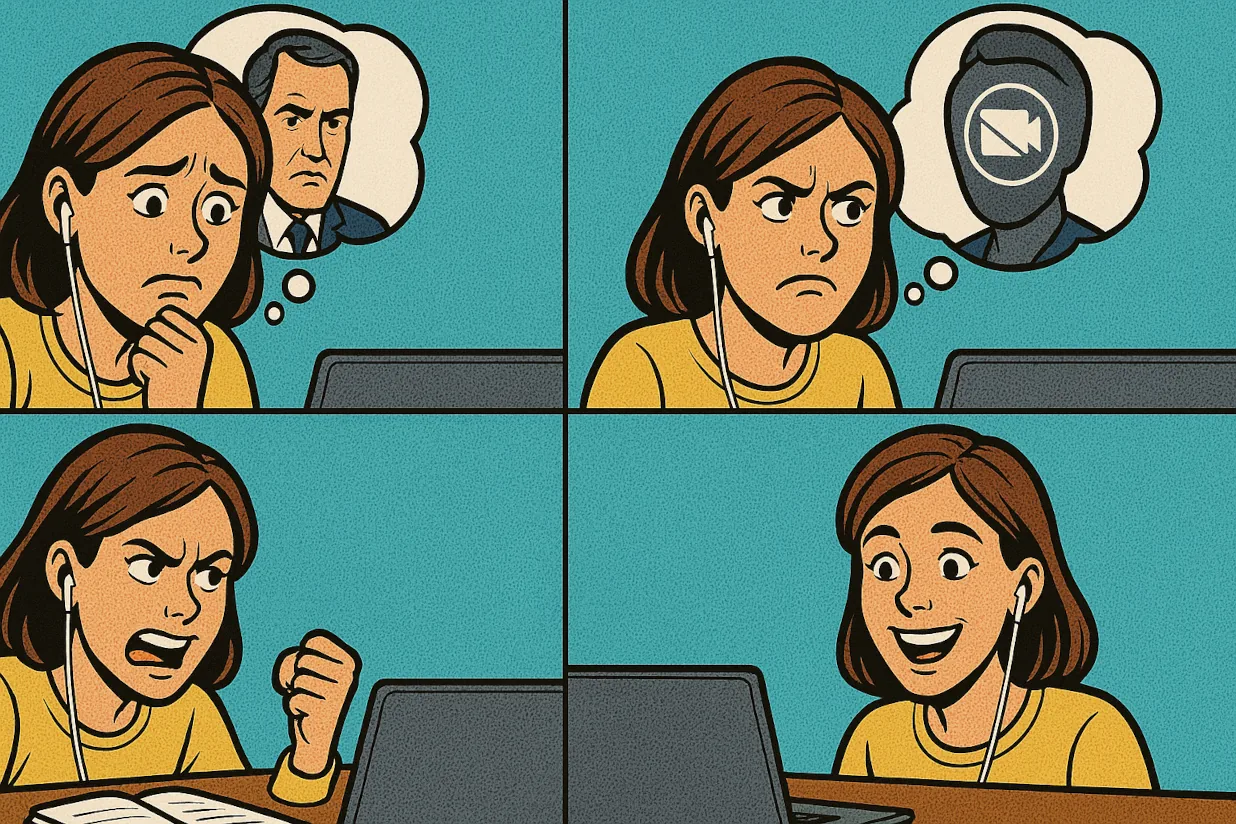
⭕ Camera off interviewers. Seriously? How is that respectful? 😤
It’s a conversation, not a voice-over test.
⭕ Stone-faced recruiters. You finish answering, and after a few seconds of silence they say, “Is that all?”
Come on. I’ve been a recruiter too. A good screening should feel like a discussion — a back-and-forth exploration of knowledge, not an interrogation.
⭕ Ghosting. You have a great chat, everything seems fine… and then nothing. Or you hear, “We’ll reach out soon,” and they never do. 🕳️
⭕ “Position closed” excuses. “Priorities have changed.” Sure. Thanks for wasting both our time.
⭕ Cliché-driven questions. They focus on trivia that fades over time or doesn’t reflect real experience. For example:
- “Describe the maturity levels of a REST API.”
- “Explain the Node.js event loop in detail.”
- "What are the AWS Well-Architected Framework's six pillars?"
- …and other textbook nonsense that doesn’t define a professional’s worth.
⭕ Superficial evaluation. Too many interviews test shallow knowledge instead of real-world ability.
⭕ Unrealistic expectations. I’m not Google or ChatGPT 😅
Once, a recruiter was shocked I couldn’t recall “Proof Key for Code Exchange (PKCE)” by name — even though I knew when to use it.
⭕ Ego-driven interviewers. Some just want to show off or humiliate candidates.
Like one who sneered, “And this is REST API for you?” — classy.
⭕ Unprepared interviewers. Sometimes they run out of questions halfway through, then later say, “Your Node.js knowledge isn’t deep enough.” Well, maybe ask more?
Same for frontend: I once didn’t know useMemo, and apparently that meant I “can’t React.” Never mind my years working with jQuery, Angular, Ember, Vue, and React itself. 🙃
People Often Don’t Know How to Recruit People 🤷♂️
It’s frustrating when a screening focuses solely on technical trivia instead of assessing a candidate’s real ability to solve problems.
The qualities I value most in my teams go far beyond remembering syntax or frameworks. I look for people who can work independently, think analytically, communicate well, and show a self-driven attitude. I value curiosity, adaptability, pragmatism, and the eagerness to learn and grow.
With today’s tools — especially LLMs — anyone can quickly verify information, explore new topics, or gain a basic understanding of unfamiliar areas. What truly matters is not what you already know, but how you approach learning and problem-solving. 🚀
How to Manage Your Stress Before an Interview 🧘
Earlier, I quoted a paper that said that crucial is prediction, and planning, which help avoid or prepare for future stressors.
Here's a list of things you can do, which are in your control and power, that can help you with that:
🟢 Prepare early. It helps twice — you’ll be better informed and more confident. Use the job description to generate likely questions (AI tools can help).
🟢 Research the company. Know what they do, their values, and their culture.
🟢 Check out the interviewers on LinkedIn. A little insight can make small talk easier and reveal useful context.
🟢 Craft a short, clear self-introduction. Practice it until it flows naturally — this creates a strong first impression.
🟢 Prepare stories. Choose 1–2 recent or interesting projects and highlight the parts most relevant to the role.
🟢 Own your failures. Be ready to discuss one or two — focus on what you learned and how you improved.
🟢 Practice out loud. In front of a mirror or camera. Seeing yourself helps you adjust tone and confidence.
🟢 Skip the coffee. ☕ It may raise your blood pressure and make you jittery.
🟢 Obvious but important: Use the restroom before the interview 😄
What to Do During the Interview 🎤
🟢 Make eye contact. Stay connected to the conversation — not just your thoughts.
🟢 Speak slowly and clearly. It helps you sound confident and gives your brain time to think.
🟢 Pause intentionally. Silence is okay. Use it to gather your thoughts.
🟢 Paraphrase questions. It ensures you understand them correctly — and shows active listening.
🟢 Smile. It softens tension on both sides 🙂
🟢 Respectful disagreement is fine. If an interviewer insists their opinion is the only right one, that’s a red flag 🚩.
What to Do After the Interview 💌
🟢 You’ll never cover everything in one conversation.
Send a short follow-up email summarizing key points, clarifying your answers, or adding something you forgot to mention. It shows professionalism and thoughtfulness.
Outro 🌱
At some point, I stopped treating interviews as final judgments of my worth — and started seeing them as random encounters between two imperfect humans trying to figure each other out. Sometimes it clicks, sometimes it doesn’t, and that’s okay.
The truth is, an interview says as much about the company as it does about the candidate. If the process feels cold, disorganized, or disrespectful, it’s already a sign of what’s waiting inside. So take every experience as data, not as defeat. Learn, adapt, and move on stronger.
In the end, your career isn’t shaped by one conversation — it’s shaped by how you show up again and again, no matter how random the process seems. ✨